
Modelling motivation
A framework for capturing and clarifying often muddled terms in business and in life

At the start of any calendar year, it seems almost baked in that we will spend at least some time thinking about the year ahead: what we want to change, where we want to improve, where we hope we’ll be by the end of the year.
To call these “resolutions” is, perhaps, optimistic given that the word means “a firm decision to do or not to do something.” How firm can we be about future actions, really? But the idea of looking ahead and trying to come up with a plan to change things for the better - whatever that looks like for you - is a good thing for sure.
The same thing applies in business, too. And what I’ve found interesting is that there exists a model that can help in both domains.
Injecting clarity into a model of business

I was first introduced to the Business Motivation Model (BMM) many years ago by a learned colleague of mine when we were both working as enterprise architects (EAs). It was at a time when more large, complex organisations were turning to EAs to help map out and make sense of many different aspects of the company architecture - not just information technology considerations, but also including the architecture of the business processes and strategies.
The BMM was created by the Object Management Group, and it pretty immediately struck me as something that really cut through a lot of the unnecessary ambiguity around terms that I had heard thrown around many a meeting since starting my career. Words that were often used interchangeably. Words that were supposed to provide clarity, but which often jumbled together and made things worse. Words like “strategy”, “vision”, “mission”, “goal”, “objective”, “tactic”.
Even as you read this now, your mind might be drawn to a meeting/email/conversation where exactly that has happened - where the whole thing devolved into a morass of management-speak, and where you came out of it wondering if you were actually any clearer after the meeting than you were going into it!
No? Just me then?
The BMM seemed to clarify a lot of this by focusing in on those key terms, their definitions, and the relationships between them. And I have found myself coming back to this part of the BMM time and time again, simply for that clarity.
A means to an end
The part of the BMM I have been most drawn to over time is the Core Elements section. Here, the model basically divides into two halves: the Ends the organisation is trying to achieve, and the Means by which it plans to achieve them. There are other components as well (Directives, Influencers, Assessment), but without trying to turn everyone into enterprise architects, just thinking about Ends and Means can provide a lot of clarity.
In fact, to save you reading through all 104 pages of the model specification, I created this summary diagram that to show the relationships between these core elements, to keep things simple:
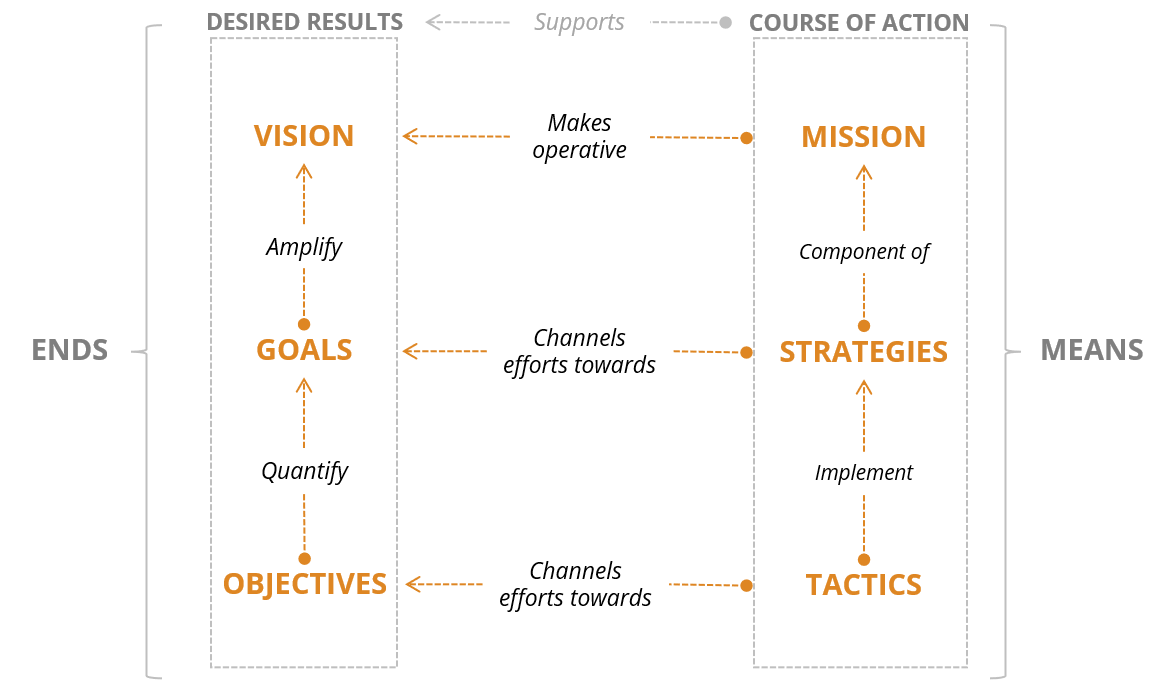
Okay, maybe at first glance it doesn’t look that simple. But let’s break it down.
On the left-hand side you have the Ends - the results that the organisation desires to achieve. Here, we start with the Vision which is defined as “the aspirational future state of the enterprise”. It is the stretchy, maybe-not-ever-fully-attainable, inspirational and motivational description of the end state for the organisation.
That Vision is then amplified by the Goals which indicate what must be satisfied to effectively attain the Vision. If the Vision is supposed to be slightly out of reach, the Goals are designed to be the milestones that we can achieve on the way to getting there. These are further quantified by the Objectives. Here, we go SMART: specific, measurable, achievable, relevant, and time-bound.
My rough rubric for defining these elements:
Vision - should start with “Be”, because it is what we want the organisation to be in the future. One of the examples from the spec is for a car rental company, the vision might be “Be the car rental brand of choice for business users in the countries in which we operate”.
Goals - should start with “To”, because they are describing what we want to achieve. Again, from the spec, the examples: “To be a ‘premium brand’ car rental company”, or “To provide industry-leading customer service”.
Objectives - the key word here is “By”, because we are setting the measurement by which we will quantify the Goal. “By end of current year, be rated by A C Nielsen in the top 9 car rental companies in all other operating countries” or “By end of current year, to score 85% on quarterly customer satisfaction survey”.
Plotting the course
Then, on the right-hand side of the model, we have the Means - the course of action that we are plotting in order to try and achieve the Ends we have outlined. At the top, the Mission is a description of what the business “is or will be doing on a day-to-day basis”. This is not the place for inspiration, or aspiration, but rather it is an action-oriented statement of purpose. Of function.
The Mission is then broken down into one or more Strategies. The definition from the BMM has a Strategy as being “accepted by the enterprise as the right approach to achieve its Goals, given environmental constraints and risks”. Again, not aspirational or inspirational, but a choice of approach - a course of action - that can be taken to achieve what the organisation desires.
Tactics implement the Strategies. They are the details, the sub-steps, the particular actions to be taken. I really like this because I was always a bit bothered with strategic vs. tactical discussions. This is where someone would say “well, we don’t have time for the strategic option, so we’ll just take a tactical approach”…but really, what they meant was to take a non-strategic approach (which no one likes to admit), because a Tactic should be part of a wider Strategy.
In terms of defining these components of Mission, Strategy and Tactic, the rule of thumb for me here is verbs. The more active and direct, the better. The left-hand side is open to all sorts of nouns, adjectives and “soft” verbs - “Be the best…”, “Grow by x%…”, “To win…” But the right-hand side is the course of action. Very hard to take action to directly “Grow” or “Improve”, for example. Much easier to “Create”, “Build”, “Deploy”, “Experiment” etc.
Getting clear on all of this has really helped me double-check my professional strategy work: am I defining a clear, verb-heavy course of action that can be followed on the path to achieving one or more clearly defined Goals? Or am I really just dressing up lofty Vision or Goal language as a quasi-Strategy and wondering why people are getting confused about what action to take?
Good for the goose…
The BMM has served me well when it comes to sifting and sorting through the parts of modelling the architecture of a business. But, interestingly, I have also found it beneficial when applied to planning out aspects of my personal life as well.
I have, in effect, created a Personal Motivation Model. Written on one page, I have a Vision for where I’d like to be in 5-10 years. I then set a few Goals - trying to cover professional, physical/fitness, emotional/relationship and spiritual dimensions - and break those down into more actionable Objectives. Then I have a Mission statement, which is more enduring; I review it every few years. Building off that, I list a course of action - Strategies and Tactics - that I will deploy to try and achieve the aforementioned goals.
It’s far from perfect, and your mileage may vary if you’re using it in a personal capacity. In my case, though, having the structure and simple definitions of the model has helped ground otherwise lofty conversations into action. “Okay, that’s great that I have a goal to improve my fitness, but what is your strategy going to be to channel efforts towards that?” It doesn’t make it any easier to actually get up and work out, but it does make clearer to me why I’m doing it!
And if I am not achieving the desired results in a particular area as quickly as I would like, the model can guide my assessment of what to do about it. Are the Objectives actually SMART? Did I make an assumption about a Tactic that I now have better data about, and should I change course? Is the Strategy overall something that needs an overhaul? Was the Goal actually unachievable, realistically?

In addition to this, every year, my incredible wife and I lock out some time to look at the Ends we are trying to achieve for our family too, and the Means by which we’re looking to achieve them. It’s a far more interesting conversation than it might seem, though! For starters, there are no whiteboards or post-its, and it’s nearly always a conversation taking place on a sunny New Zealand beach.
We take an afternoon and have a chat about, what is in effect, our Family Motivation Model: what do we want to get done this year, next year, five years out? What would serve as markers to see us making progress towards those goals? Then we talk about our ideas for achieving those: what actions are we going to deploy to try and get those results? What approaches do we need to continue with, or change, based on where we’re at? Then we try and step back and ask: does all of this still line up with our vision for our family? Especially as we look ahead beyond the year in front of us? Are we on track?
It might not be for everyone, but it seems to work for us. And there is something very rewarding about reviewing and checking off longer-term goals - looking back and seeing what we wrote 5 years ago, for example, and seeing how far we’ve come. Not to mention also having a chuckle at how naïve (or optimistic) we sometimes are when planning things out!
No such thing as too much clarity
In business and in personal life, I think clarity can often be a precious (and rare) commodity! So, if you find yourself going into strategic planning sessions, or staring at the calendar as a new year gets underway wondering what you are going to go after this year, maybe take a look at the BMM (or PMM or even an FMM) and think about it as an extra tool for your toolbox. I hope it helps you as much as it has helped me.